
Are you confused about which chapters of Chemistry are most important for the 10th class exams 2026? Do you want a clear answer to the common student question: “Chapter-wise questions kahan se aate hain?” If yes, then this article is exactly for you. This 10th Chemistry 2026 Pairing Scheme Rawalpindi Board guide explains everything chapter-wise, so you can prepare smartly, not blindly.
What Is the Chemistry Pairing Scheme?
The pairing scheme is an exam-focused plan that shows how different chapters are distributed across MCQs, short questions, and long questions. Instead of studying the entire book with equal effort, students can use the pairing scheme to focus more on high-weight chapters.
For Rawalpindi Board students, the Chemistry pairing scheme 2026 is especially useful because it highlights where numericals, reactions, and conceptual questions usually come from.
Chapter-Wise MCQs Distribution (10th Chemistry 2026)
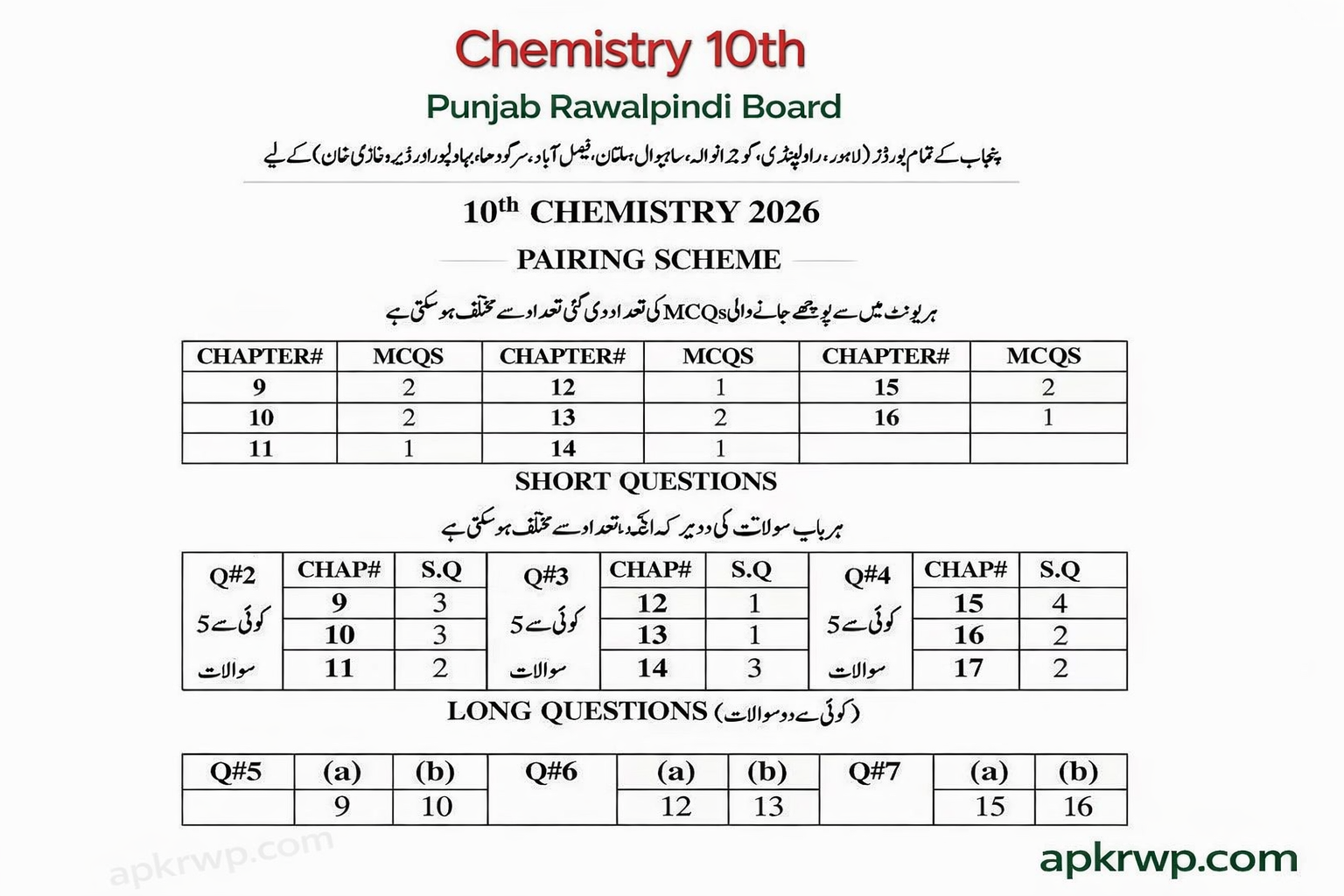
MCQs test basic concepts, definitions, formulas, and reactions. According to the pairing scheme, MCQs are distributed as follows:
- Chapter 9 → 2 MCQs
- Chapter 10 → 2 MCQs
- Chapter 11 → 1 MCQ
- Chapter 12 → 1 MCQ
- Chapter 13 → 2 MCQs
- Chapter 14 → 1 MCQ
- Chapter 15 → 2 MCQs
- Chapter 16 → 1 MCQ
Preparation Tip:
Revise formulas, definitions, and key reactions daily. MCQs are scoring and should never be ignored.
Chapter-Wise Short Questions Pairing
Short questions check your understanding in brief answers. They are divided into three main questions, each with internal choice.
Q#2 (Attempt any 5)
- Chapter 9 → 3 short questions
- Chapter 10 → 3 short questions
- Chapter 11 → 2 short questions
Q#3 (Attempt any 5)
- Chapter 12 → 1 short question
- Chapter 13 → 1 short question
- Chapter 14 → 3 short questions
Q#4 (Attempt any 5)
- Chapter 15 → 4 short questions
- Chapter 16 → 2 short questions
- Chapter 17 → 2 short questions
Expert Tip:
Write short answers in points, use correct chemical terms, and avoid unnecessary explanations.
Chapter-Wise Long Questions Pairing Scheme
Long questions carry high marks and require detailed explanations, equations, or numericals. The pairing scheme clearly shows chapter options:
Q#5
- (a) Chapter 9
- (b) Chapter 10
Q#6
- (a) Chapter 12
- (b) Chapter 13
Q#7
- (a) Chapter 15
- (b) Chapter 16
Students attempt one part only from each question, so choosing well-prepared chapters is key.
Pak Studies Class 10 Pairing Scheme 2026
Most Important Chapters (High-Scoring Focus)
Based on the pairing scheme, the most important chapters are:
Chapters 9, 10, 12, 13, 15, and 16
These chapters appear in MCQs, short questions, and long questions, making them extremely important for final marks.
Smart Study Strategy Using the Pairing Scheme
- Study with the pairing scheme beside you
- Practice numericals from long-question chapters regularly
- Revise MCQs daily from all listed chapters
- Solve past papers to understand examiner trends
- Focus on neat presentation and balanced equations
Final Words
The 10th Chemistry 2026 Pairing Scheme Rawalpindi Board is a powerful tool for exam success. When you clearly know which chapter appears in which question, your preparation becomes focused, confident, and effective. Instead of studying everything randomly, follow the chapter-wise pairing scheme and prepare strategically.