
Are you a 9th class student preparing for the Chemistry exam under the Rawalpindi Board?
Are you confused about which chapters carry more marks, or how the question paper is structured in 2026? If yes, then this guide will help you plan your preparation the smart way.
In this article, we break down the latest Pairing Scheme of 9th Class Chemistry 2026 (Rawalpindi Board) — chapter by chapter, question by question. You’ll learn exactly how many MCQs, short questions, and long questions come from each chapter so you can study with confidence and focus on high-impact topics.
📌 What Is a Pairing Scheme?
A pairing scheme is an exam guideline used by educational boards to map out how questions are distributed across different chapters. It tells you:
✔ How many MCQs will come from each chapter
✔ How many short questions and from which chapters
✔ Which chapters provide long questions
✔ The total marks assigned to each chapter
For students, a pairing scheme is a score booster — it helps you eliminate guesswork and prepare smartly.
🧪 Exam Structure: 9th Class Chemistry (2026)
Under the Rawalpindi Board, the Chemistry paper (theory) carries a total of 60 marks distributed as follows:
| Question Type | Total Marks | Details |
|---|---|---|
| MCQs | 12 | 12 questions × 1 mark |
| Short Questions | 24 | Groups with choices |
| Long Questions | 24 | 3 questions with sub-parts |
| Total | 60 | — |
This full-length theory paper tests both concept clarity and application skills.
📊 Chapter-wise Weightage (2026)
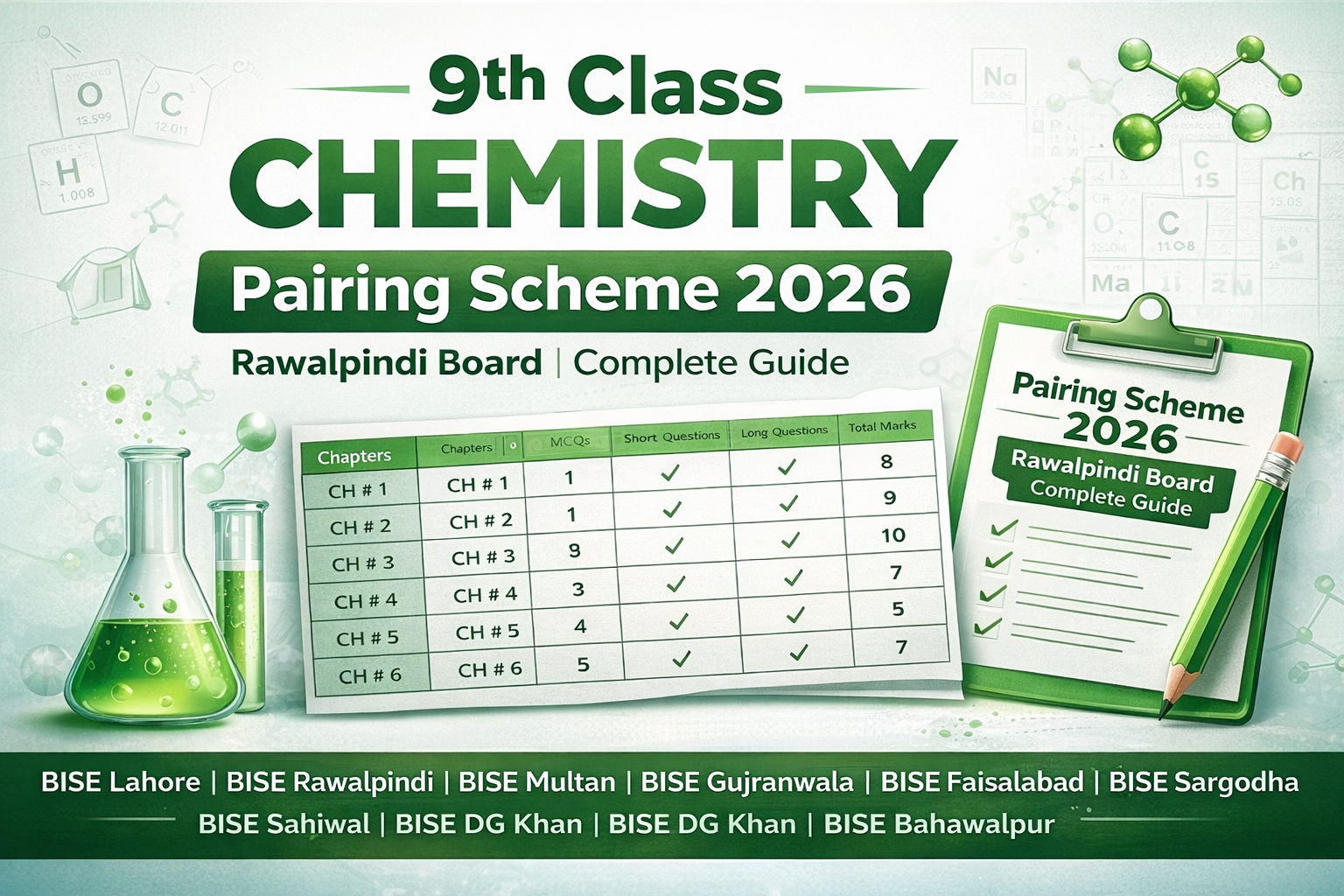
Understanding which chapters carry more marks gives you a strategic advantage. Below is the chapter weightage according to the latest pairing scheme:
| Chapter # | Topic Name | Total Marks |
|---|---|---|
| Chapter 1 | Fundamentals of Chemistry | ~8 |
| Chapter 2 | Atomic Structure | ~9 |
| Chapter 3 | Chemical Bonding & Reactions | ~10 |
| Chapter 4 | Periodic Table | ~7 |
| Chapter 5 | Acids, Bases & Salts | ~7 |
| Chapter 6 | Matter & Its States | ~5 |
| Chapter 7 | Mixtures & Compounds | ~7 |
| Chapter 8 | Chemical Calculations | ~10 |
| Chapter 9 | Organic Chemistry Basics | ~7 |
| Chapter 10 | Water & Solutions | ~9 |
| Chapter 11 | Environmental Chemistry | ~8 |
👉 Top marks are concentrated in Chapters 3, 8, 2, and 10.
Focus more on these chapters for maximum score!
✔ MCQs: How They Are Distributed
- Each chapter contributes at least 1 MCQ.
- Some chapters include 2 MCQs.
- MCQs are designed to test basic concepts, formulas, and definitions.
📌 Example: From Chapter 3 (Chemical Reactions) you might get definitions of reaction types like synthesis, decomposition, etc.
💡 Pro Tip: MCQs account for 12 marks — don’t skip even tough-sounding topics.
✏ Short Questions (Helpful Strategy)
Short questions are divided into groups. You usually attempt a fixed number from each group, and they come from:
✔ Definitions
✔ Balancing equations
✔ Simple calculations
✔ Concept explanations
📍 Chapters like 2, 3, 7, and 9 often appear in short questions.
Tentative: 9th Class Date Sheet 2026 Rawalpindi Board
Study Tip: Create flashcards for definitions and formulas — short questions often repeat core concepts.
📘 Long Questions: Key Chapters
Long questions are the heart of your exam. They usually require:
✔ Detailed explanations
✔ Numerical problems
✔ Application of concepts
✔ Chemical equations
According to the 2026 plan, long questions mostly come from:
🔥 Chapter 3 – Chemical Reactions
🔥 Chapter 8 – Chemical Calculations
🔥 Chapter 10 – Water & Solutions
These chapters carry repeated long-question opportunities, so revise them thoroughly.
🎯 Smart Preparation Tips (Pro Guide)
Here’s how to use the pairing scheme to your advantage:
✔ Step 1: Identify High-Weight Chapters
Start with chapters that carry 8–10 marks.
✔ Step 2: Master MCQs First
Since they are easy to secure marks, practice all MCQs.
✔ Step 3: Do Short Qs by Topic
Group similar chapters and solve practice questions.
✔ Step 4: Drill Long Questions
Fully understand mechanisms, theory, and calculations.
✔ Step 5: Revise with Past Papers
Past papers follow the same pattern — revision here is gold!
🎓 Final Takeaway
The Pairing Scheme of 9th Class Chemistry 2026 (Rawalpindi Board) simplifies your study plan and highlights what really matters. Use this guide to study strategically, practice hard, and score confidently.