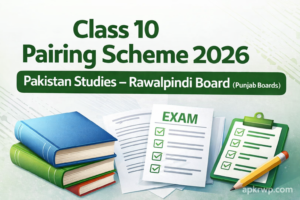

Are you a Class 10 student in the Rawalpindi Board looking for the most accurate and updated Pakistan Studies pairing scheme for 2026? Wondering which chapters you MUST focus on to score higher in exams?
This guide gives you a simple, student-friendly, and up-to-date breakdown of the pairing scheme so that you can prepare smartly and strategically.
📌 What Is the Pairing Scheme?
A pairing scheme is a chapter-wise weightage chart that shows where questions are most likely to come from in the final exam. It doesn’t guarantee exact questions, but helps you focus on chapters with higher probability of appearing in MCQs, short questions, and long questions.
The pairing scheme below is based on the latest pattern for Pakistan Studies Class 10 (2026) for the Rawalpindi Board.
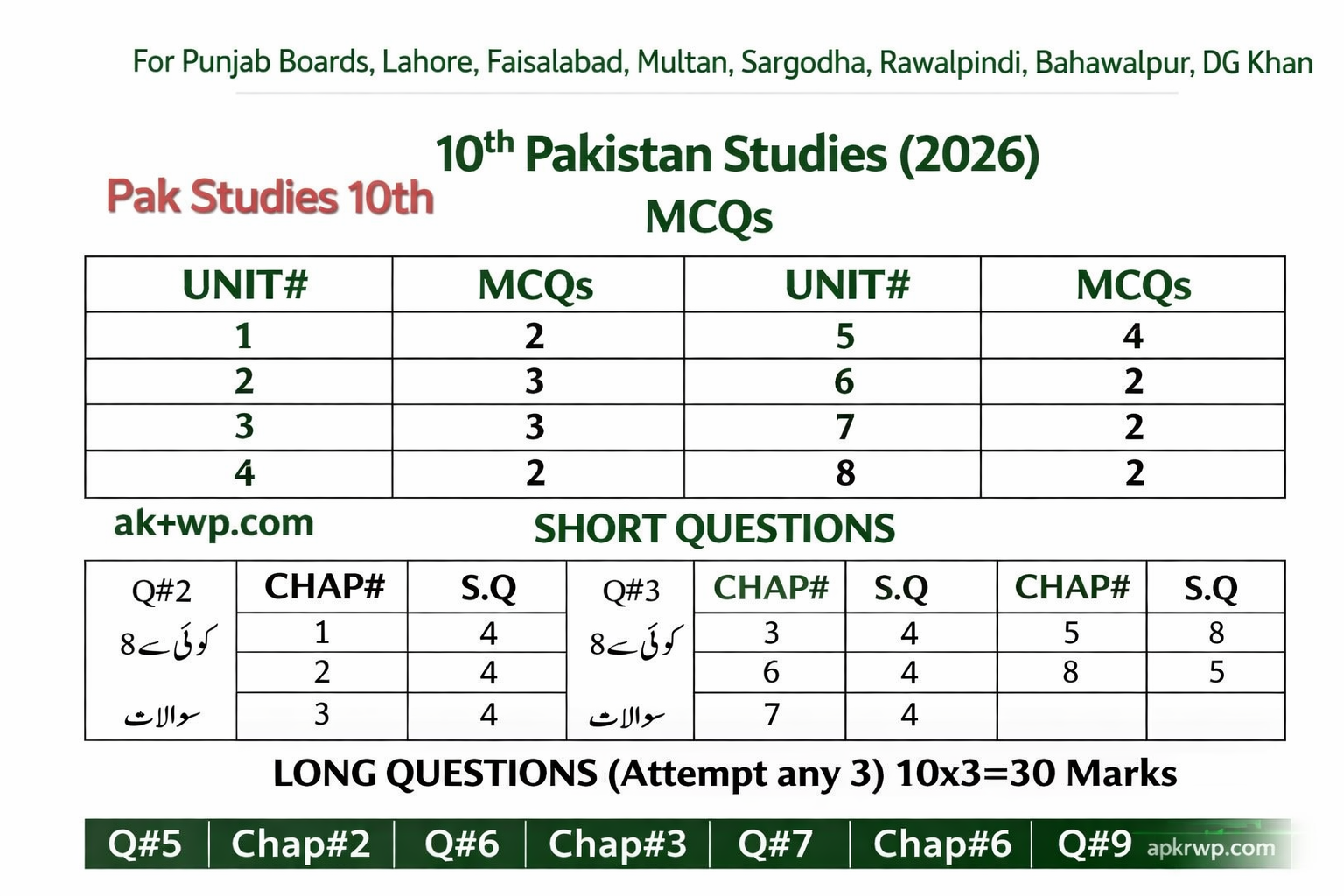
✏️ MCQs Distribution (2026)
The MCQs section usually consists of 20 marks/questions. Each unit contributes a certain number of MCQs:
| Unit | MCQs |
|---|---|
| Unit 1 | 2 |
| Unit 2 | 3 |
| Unit 3 | 3 |
| Unit 4 | 2 |
| Unit 5 | 4 |
| Unit 6 | 2 |
| Unit 7 | 2 |
| Unit 8 | 2 |
📌 Smart Tip: Unit 5 has the most MCQs, making it one of the most important units to revise carefully.
🧠 Short Questions Section
Short questions are usually divided into three groups, and students pick a defined number from each.
Section A
- Chapters: 1, 2, 4
- Short Questions from each: 4
- Attempt Any 8 Questions
Section B
- Chapters: 3, 6, 7
- Short Questions from each: 4
- Attempt Any 8 Questions
Section C
- Chapters: 5, 8
- Short Questions:
- Chapter 5 → 8 questions
- Chapter 8 → 5 questions
- Attempt Any 9 Questions
➡️ Observation: Short questions from Chapter 5 and 8 have heavier weightage than others.
📝 Long Questions (10 Marks Each)
Long questions require detailed answers and carry high weightage. These will be asked from the chapters below:
| Question | Chapter |
|---|---|
| Q#5 | Chapter 2 |
| Q#6 | Chapter 3 |
| Q#7 | Chapter 5 |
| Q#8 | Chapter 6 |
| Q#9 | Chapter 7 |
👓 Important: You must attempt any 3 long questions out of the above.
📚 What This Means for Your Preparation
Now that you understand which chapters are most significant, here’s a smart study strategy:
🎯 Focus on High-Value Chapters:
- Chapter 5
- Most MCQs
- Heavier Short Question weight
- Included in Long Questions
→ This makes it one of the most important chapters.
- Chapters 2, 3, 6, 7
- Frequent in long and short questions
→ Give proper revision time.
- Frequent in long and short questions
- Chapters 1, 4, 8
- Important for short questions
→ But lower MCQ count.
- Important for short questions
📌 Study Tips to Score Higher
✔️ Map Syllabus to Pairing Scheme: Before starting, make a checklist of topics from each chapter.
✔️ Practice Past Papers: This helps improve time management and identify question styles.
✔️ Make Short Notes: For MCQs and short answers – maintain bullet points for fast revision.
✔️ Revise Repeatedly: Revisiting chapters a few times makes retention stronger.
✔️ Answer Long Questions Neatly: Headings and short paragraphs earn better marks.
🎯 Final Thought
The Class 10 Pakistan Studies Pairing Scheme 2026 for the Rawalpindi Board is your roadmap to targeted and productive preparation. Instead of trying to study everything equally, focus on chapters with higher chances of appearing in exams.
By preparing smartly and using the pairing scheme as your guide, you’ll not only reduce stress but also maximize your score.