
feeling confused about which chapters are more important? Don’t worry. Understanding the Class 10 Computer Science Pairing Scheme 2026 can completely change the way you prepare and help you score better with less stress.
This article explains the latest pairing scheme for Computer Science (10th class) – Rawalpindi Board, based on the most recent paper pattern followed by Punjab Boards.
What Is the Pairing Scheme and Why It Matters?
The pairing scheme is a chapter-wise paper pattern that shows:
- From which chapters MCQs will be asked
- How short questions are distributed
- Which chapters are selected for long questions
Instead of studying blindly, the pairing scheme helps students focus on high-weight chapters, saving time and improving results.
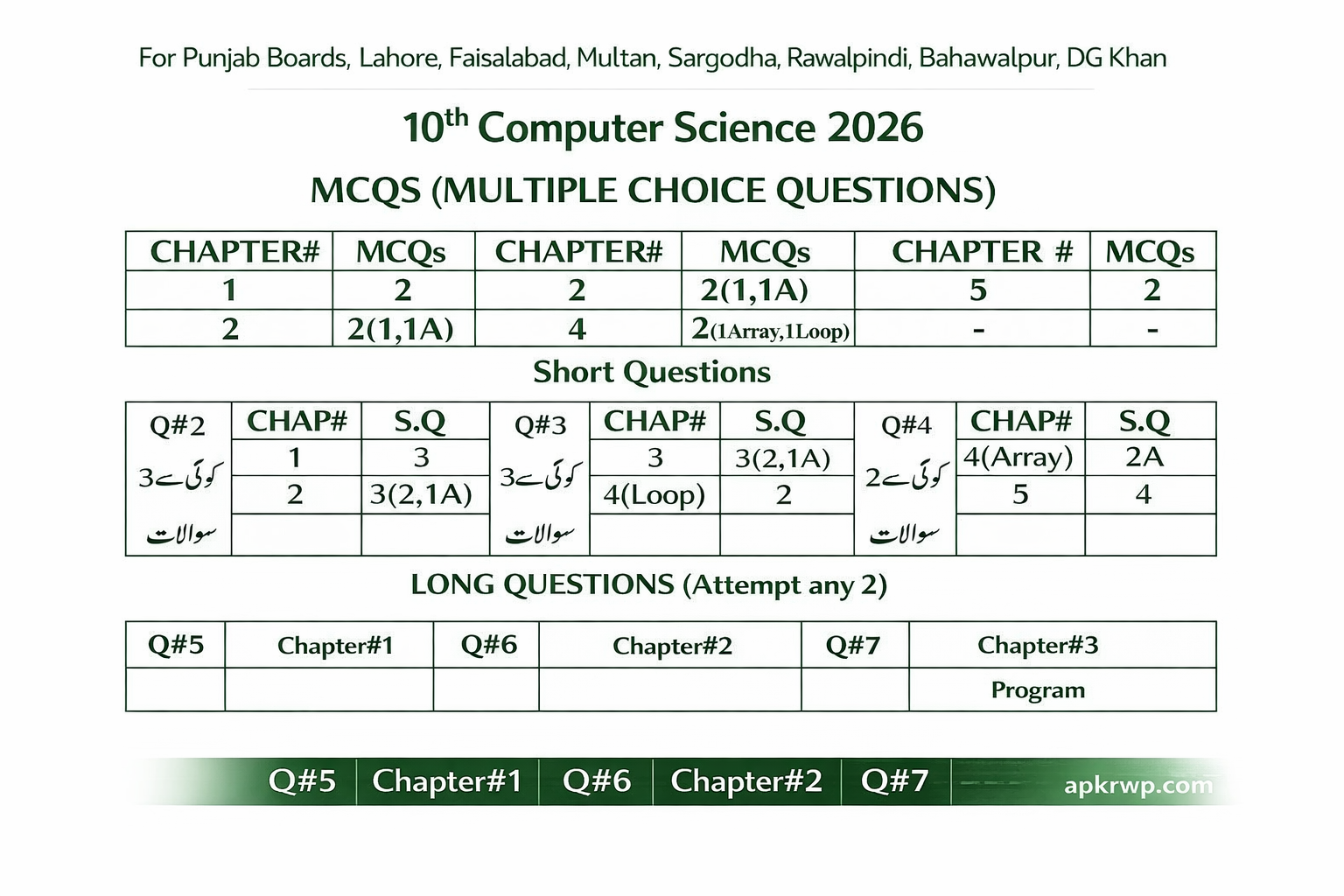
MCQs Distribution – Computer Science Class 10 (2026)
According to the latest pattern for Rawalpindi Board, MCQs are distributed as follows:
- Chapter 1: 2 MCQs
- Chapter 2: 2 MCQs (1 from theory, 1 from algorithm/IA)
- Chapter 3: 2 MCQs (1 from theory, 1 from IA)
- Chapter 4: 2 MCQs (1 from Arrays, 1 from Loop)
- Chapter 5: 2 MCQs
📌 Preparation Tip: MCQs often come from definitions, syntax, differences, and basic concepts. Daily MCQs practice can secure full marks in this section.
Short Questions Pairing Scheme (2026)
Short questions are divided into three parts, and students attempt selected questions from each.
Question #2 (Attempt any 4)
- Chapter 1 → 3 short questions
- Chapter 2 → 3 short questions (including IA)
Question #3 (Attempt any 4)
- Chapter 3 → 3 short questions (including IA)
- Chapter 4 → 3 short questions (Loop related)
Question #4 (Attempt any 4)
- Chapter 4 → 2 short questions (Array)
- Chapter 5 → 4 short questions
👉 This clearly shows that Chapter 4 (Arrays & Loops) and Chapter 5 are very important for short questions.
Long Questions Pairing Scheme – Attempt Any Two
Long questions carry high marks, so strong preparation is essential.
- Question #5: Chapter 1
- Question #6: Chapter 2
- Question #7: Chapter 3 (Program-based question)
🧠 Important Note: Program questions require logical thinking and correct syntax, so regular practice is key.
Smart Study Strategy for Computer Science 2026
To prepare effectively for the Rawalpindi Board exam:
✔ Focus more on Chapters 2, 3, and 4
✔ Practice programs and logic building daily
✔ Revise Arrays and Loops multiple times
✔ Write short answers in clear points
✔ Practice at least 5 past papers before exams
Rawalpindi Board: Class 10 Pairing Scheme 2026 Pak Studies
Final Words
The Class 10 Computer Science Pairing Scheme 2026 (Rawalpindi Board) is a powerful tool for smart students. If you follow it properly, you can reduce unnecessary workload and focus only on what truly matters in the exam.
Study smart, not hard — and let the pairing scheme guide your preparation.
Best of luck for your Board Exams 2026! 📘💻