
Are you a Grade 8 student or teacher trying to understand the latest PECTAA pairing scheme of Science and wondering how the paper will actually be structured? You’re not alone. Every year, students lose marks simply because they don’t understand the pairing scheme properly. The good news is that once you understand it, exam preparation becomes much easier and more strategic.
In this guide, you’ll find a clear, updated, and student-friendly explanation of the Grade 8 PECTAA Science Pairing Scheme, designed to help you prepare smartly and score better.
What Is the Grade 8 PECTAA Pairing Scheme of Science?
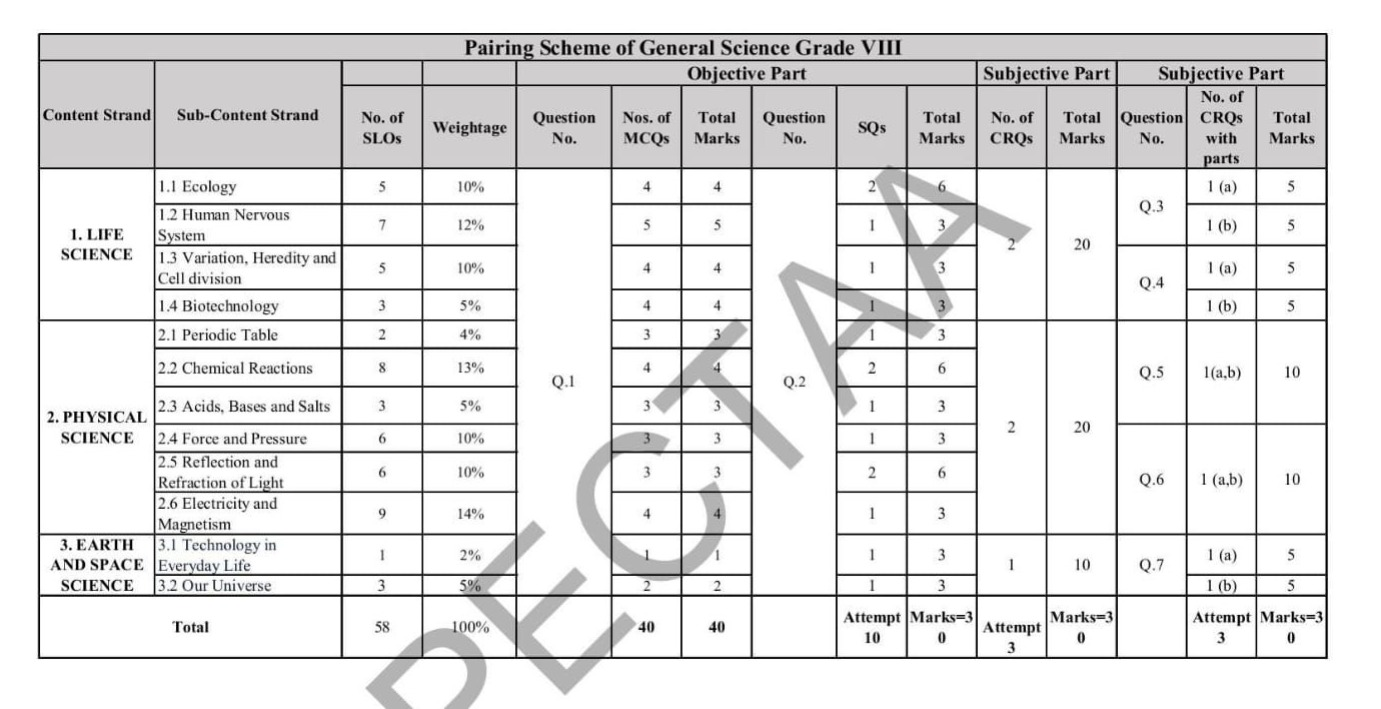
The PECTAA pairing scheme is an official exam blueprint that explains how questions are distributed in the Grade 8 Science paper. It shows:
- Which chapters are included
- How many MCQs, short questions, and long questions come from each topic
- The marks distribution across Life Science, Physical Science, and Earth & Space Science
Understanding this scheme helps students focus on high-weightage topics and avoid wasting time on less important areas.
Structure of Grade 8 Science Paper (PECTAA)
According to the latest Grade 8 PECTAA Science pairing scheme, the paper is divided into three main parts:
1. Objective Part (MCQs)
- Total MCQs: 40
- Each MCQ carries 1 mark
- Questions are taken from all content strands
- MCQs test basic concepts, definitions, and understanding
👉 Preparation Tip: Revise key definitions, formulas, and concepts from every chapter.
2. Subjective Part – Short Questions (SQs)
- Short questions are based on selected chapters
- Each short question carries 3 marks
- Questions are usually asked from:
- Ecology
- Human Nervous System
- Chemical Reactions
- Force and Pressure
- Electricity and Magnetism
👉 Expert Tip: Practice writing short, to-the-point answers with correct scientific terms.
3. Subjective Part – Long Questions (CRQs)
- Long questions are divided into parts (a) and (b)
- Each long question carries 10 marks
- Questions are selected from major chapters only
- Diagrams, explanations, and examples are often required
👉 Scoring Strategy: Always attempt the question you are most confident in. Neat diagrams can significantly boost marks.
Content Strands Included in Grade 8 Science
The PECTAA Grade 8 Science syllabus is divided into three main strands:
🔬 Life Science
- Ecology
- Human Nervous System
- Variation, Heredity & Cell Division
- Biotechnology
⚗️ Physical Science
- Periodic Table
- Chemical Reactions
- Acids, Bases & Salts
- Force and Pressure
- Reflection & Refraction of Light
- Electricity and Magnetism
🌍 Earth and Space Science
- Technology in Everyday Life
- Our Universe
Difference Between: Federal Board and Punjab Board
Each strand carries a specific weightage, so balanced preparation is essential.
Why the Pairing Scheme Is Important for Students
The Grade 8 PECTAA pairing scheme of Science is not just a document—it’s a roadmap. It helps students:
- Understand exam patterns
- Prepare smartly instead of studying blindly
- Manage time during exams
- Focus on high-scoring topics
- Reduce exam stress and confusion
Teachers also use it to design tests and revision plans.
Smart Preparation Tips Based on Pairing Scheme
- ✔️ Start with high-weightage chapters
- ✔️ Practice MCQs daily
- ✔️ Write at least one long question answer per day
- ✔️ Revise diagrams and scientific terms
- ✔️ Solve past papers using the pairing scheme
Final Thoughts
The Grade 8 PECTAA Pairing Scheme of Science is your ultimate exam preparation tool. Students who understand and follow it always perform better because they study with direction and confidence. Instead of guessing what will come in the paper, you already know the structure—now all you need is consistent practice.