
Are you a 10th class student preparing for your Urdu exam 2026 under the Rawalpindi Board? Are you worried about which topics are most important or how the paper will be divided? If yes, you’re in the right place. The Urdu 10th Class Paper Pairing Scheme 2026 is designed to guide students and help them focus on the key areas that carry marks.
Understanding the pairing scheme not only saves time but also ensures you concentrate on the topics that are most likely to appear in the exam. Let’s break it down for better preparation.
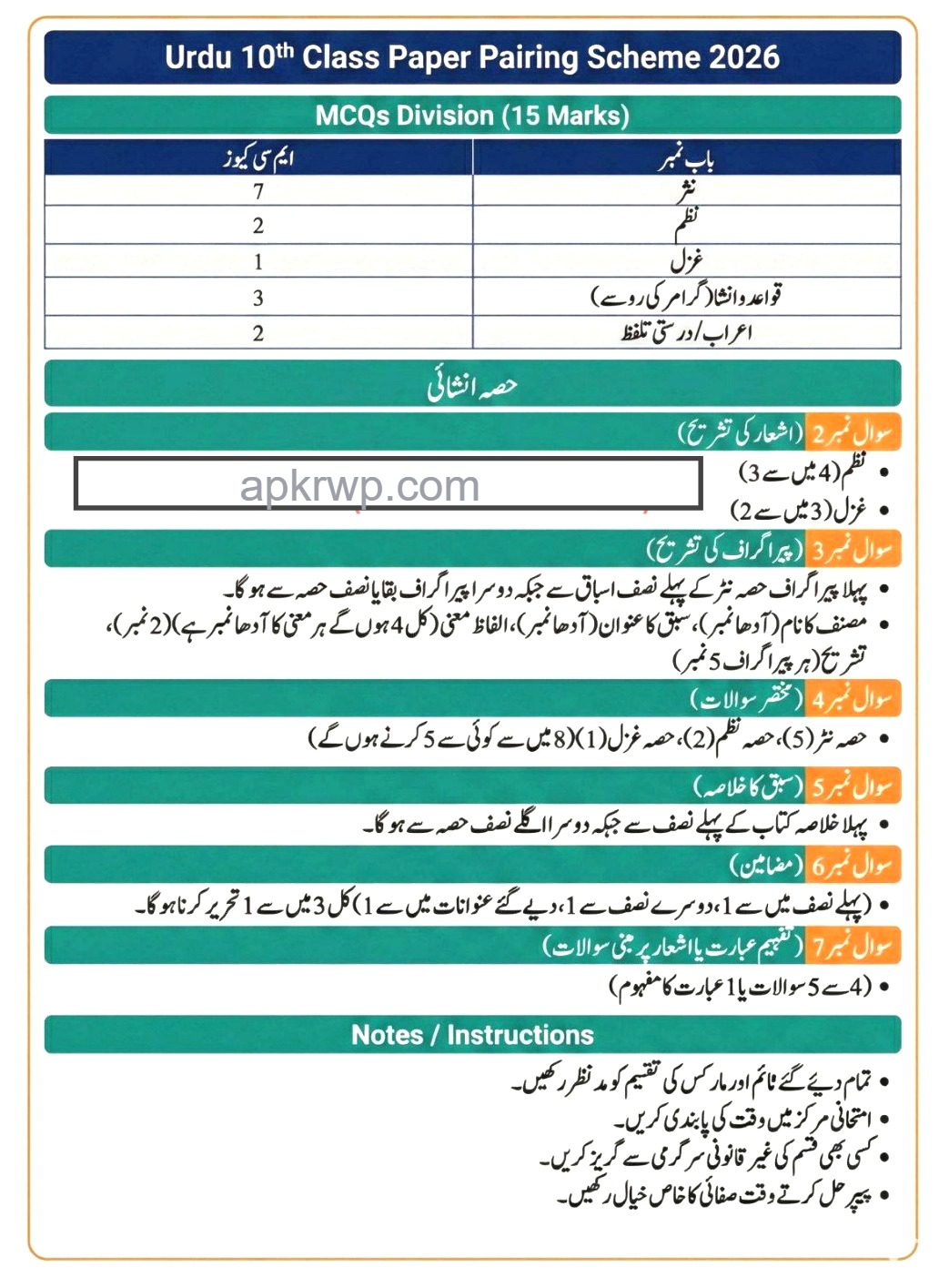
MCQs Division – 15 Marks
The first part of the Urdu paper consists of Multiple Choice Questions (MCQs). The 2026 pairing scheme clearly specifies the marks distribution:
| Chapter / Topic | Number of Questions |
|---|---|
| Nazm | 7 |
| Qasida | 2 |
| Ghazal | 1 |
| Qaida-o-Usul (Grammar) | 3 |
| Arabi aur Talafuz | 2 |
Tip: Focus on these chapters thoroughly. Practice MCQs from past papers to get a clear idea of the commonly asked questions.
Written Portion – Subjective Questions
The written section is divided into carefully selected questions by the Rawalpindi Board. Here is the key breakdown for 2026:
Question 2 – (Short Questions)
- 3 marks each for 3 questions
- 2 marks for simpler answers
Question 3 – (Grammar)
- Includes paragraph formation, sentence correction, and vocabulary usage.
- Marks distribution follows 1 mark to 2 marks depending on difficulty.
Question 4 – (Essay / Composition)
- Focuses on expressing ideas clearly in Urdu.
- Students must practice letter writing, essay, and story composition.
Question 5 – (Translation / Recitation)
- Students may be asked to translate passages or recite poetry.
- Practice translation from Urdu to English and vice versa.
Question 6 – (Advanced Grammar)
- Questions from Qaida-o-Usul may include sentence formation or grammar rules.
- Marks range from 1 to 3 depending on complexity.
Question 7 – (Optional / Miscellaneous)
- Usually includes short comprehension or poetry analysis.
- Prepare all previous years’ papers for guidance.
Rawalpindi Boards: Physics 10th Class Pairing Scheme 2026
Notes / Instructions for Students
The Rawalpindi Board provides the following guidelines along with the pairing scheme:
- Ensure you cover all selected chapters as per the pairing scheme.
- Do not ignore smaller sections; even 1 or 2 mark questions are important.
- Focus on grammar and vocabulary, as they carry marks in multiple questions.
- Practice past papers and sample questions to improve speed and accuracy.
Pro Tip: Allocate study time based on marks weightage. Spend more time on chapters like Nazm and Grammar, which have higher marks, and revise smaller sections daily.
How to Use the Pairing Scheme Effectively
- Step 1: Review the entire Urdu syllabus and highlight chapters listed in the pairing scheme.
- Step 2: Divide your preparation time according to marks allocation. For example, MCQs and Nazm deserve more attention.
- Step 3: Practice writing essays and letters from previous papers; they often repeat in exams.
- Step 4: Regularly test yourself on MCQs and grammar questions.
- Step 5: Make a quick revision sheet for Arabi and Talafuz rules to memorize easily.
Conclusion
The Urdu 10th Class Paper Pairing Scheme 2026 (Rawalpindi Board) is an essential tool for students aiming to score high marks. By focusing on the highlighted chapters, practicing MCQs, and revising grammar thoroughly, students can maximize their scores.
Remember, preparation with a strategy based on the pairing scheme is much more effective than random studying. Start early, practice regularly, and you will see the results in your Urdu 10th class exam 2026.